
Thomasville City Directory Holdings
Thomasville has a documented run of historical directories, not just a general suggestion to ask a library. DigitalNC provides scans tied to underlying UNC Wilson Library material, while Davidson County library and museum resources supply local help, maps, and related files. The known run begins with 1928-29 and continues through 1962-63, although the research did not establish either the town's first directory or its final printed edition. Treat a scan as a dated surrogate: record its title, year, publisher, page, and the collection that supplied it before drawing a conclusion about a household.
| Collection | Years | Where Held | Access |
|---|---|---|---|
| Commercial Service and Miller series | 1928-29, 1930-31, 1941-42, 1943, 1945, 1947-48 | DigitalNC with UNC Wilson Library metadata | Open the title record, then use its page or PDF options |
| Carolina Directory Co. and Baldwin Directory Co. volumes | 1933-34 and 1935 | DigitalNC and local-history research channels | Digitized access; ask staff about the local copy |
| Miller and Southern Directory Co. volumes | 1949, 1951, 1954, 1956-57, 1958-59, 1960-61, 1962-63 | DigitalNC, UNC Wilson, and Davidson research collections | Digitized title records and in-person referral help |
| Supporting maps, newspapers, yearbooks, and vertical files | Dates vary by collection | Thomasville Public Library, Genealogy and History Room, Historical Museum | Library research assistance, appointment, or collection inquiry |
The corrected 1958-59 DigitalNC record matters because the museum resource list has an apparent Lexington-link error for that Thomasville volume, and a similar problem affects the 1960 listing. Compare the title page with the metadata rather than relying on a copied list. The collection table is also a reminder that skipped publication years are gaps in the shelf, not evidence that a household disappeared.
Thomasville City Directory Publishers
Publisher changes help explain differences between Thomasville city directories. The early books include Miller and Commercial Service Co. material. Carolina Directory Co. issued the 1933-34 volume, Baldwin Directory Co. worked with Thomasville News on the 1935 book, and later volumes return largely to the Miller name, with Southern Directory Co. appearing with the 1949 volume. A name found in one edition should be compared with the rules and arrangement printed in that edition instead of assuming every book gathered information in the same way.
The 1928-29 and 1930-31 editions, for example, are available through their own DigitalNC and DigitalNC records. The 1933-34 record has a general index and detailed address entries, while the 1941-42, 1943, and 1945 volumes provide successive wartime and postwar points for comparison. That sequence can show a move, a changed street label, or a shift in the way the publisher recorded a name. It cannot, by itself, establish why a change occurred.
A visit to the Davidson Genealogy and History Room can add newspapers, maps, yearbooks, and county books to a directory question.
Staff assistance and the room's combined holdings make it a better next stop when a scan raises a question that only a map, obituary index, or physical reference item can answer.
Thomasville's 1935 Directory Canvass
The 1935 Thomasville directory is unusually candid about how it was assembled. Its preface says the publisher used a house-to-house canvass and material from local businesses. For people over 16, it aimed to collect a full name, spouse name, children under 16, home ownership, position or business association, and home address. That makes the book valuable for a narrow historical question, yet the stated method is also a limit. A canvasser could miss a household, and the publisher's categories are not a modern definition of identity or residence.
The 1935 preface directs readers to a general index and an abbreviation page. Start with those pages before copying an entry. They show what the publisher intended a mark to mean and whether a line belongs in an alphabetical, street, or business portion of the book. The edition is best used alongside a second dated source, such as a map, obituary index, or deed, when an address is important to a family-history question.
- 1928-29: an early documented Thomasville directory point in the digitized run.
- 1933-35: Carolina and Baldwin volumes add the general-index and canvass context.
- 1941-49: Miller volumes create several wartime and postwar comparison points.
- 1951-63: later Miller editions continue the address, spouse, and listed-role pattern.
Note: The available records establish a documented run, not a promise that every Thomasville directory year was published or survives.
Read a Thomasville City Directory Entry
A Thomasville city directory entry is compact, but its parts need to stay separate. The 1933-34 abbreviation key defines h as householder, r as roomer or resides, and RD as Rural Delivery. The book also uses shortened forms for terms such as agent, assistant, bookkeeper, clerk, domestic worker, laborer, and teacher. Those marks are source vocabulary. They identify how that edition described a person, not a present-day status or a full account of the household.
| Name line | Copy the name exactly, including initials and any spouse name in parentheses. |
|---|---|
| Listed role | Record the printed occupation or business association without expanding an abbreviation from memory. |
| Address | Preserve the house number, street spelling, direction, Rural Delivery notation, and page. |
| Household mark | Use the edition's key for h, r, and other marks before interpreting the relationship to the address. |
| Source note | Keep the title, year, publisher, URL, and whether the line came from a name or street section. |
- Criss-cross directory
- A street-side arrangement that lets a reader begin with an address and then identify the dated household or business line printed there.
- Householder index
- An index or notation that identifies the person the publisher treated as the household reference point. It does not establish legal ownership.
- Abbreviation key
- The publisher's glossary, usually near the front matter or index. Photograph or transcribe it before interpreting short forms.
A scan of the 1935 Thomasville directory is the clearest way to inspect the book's own title and prefatory material.
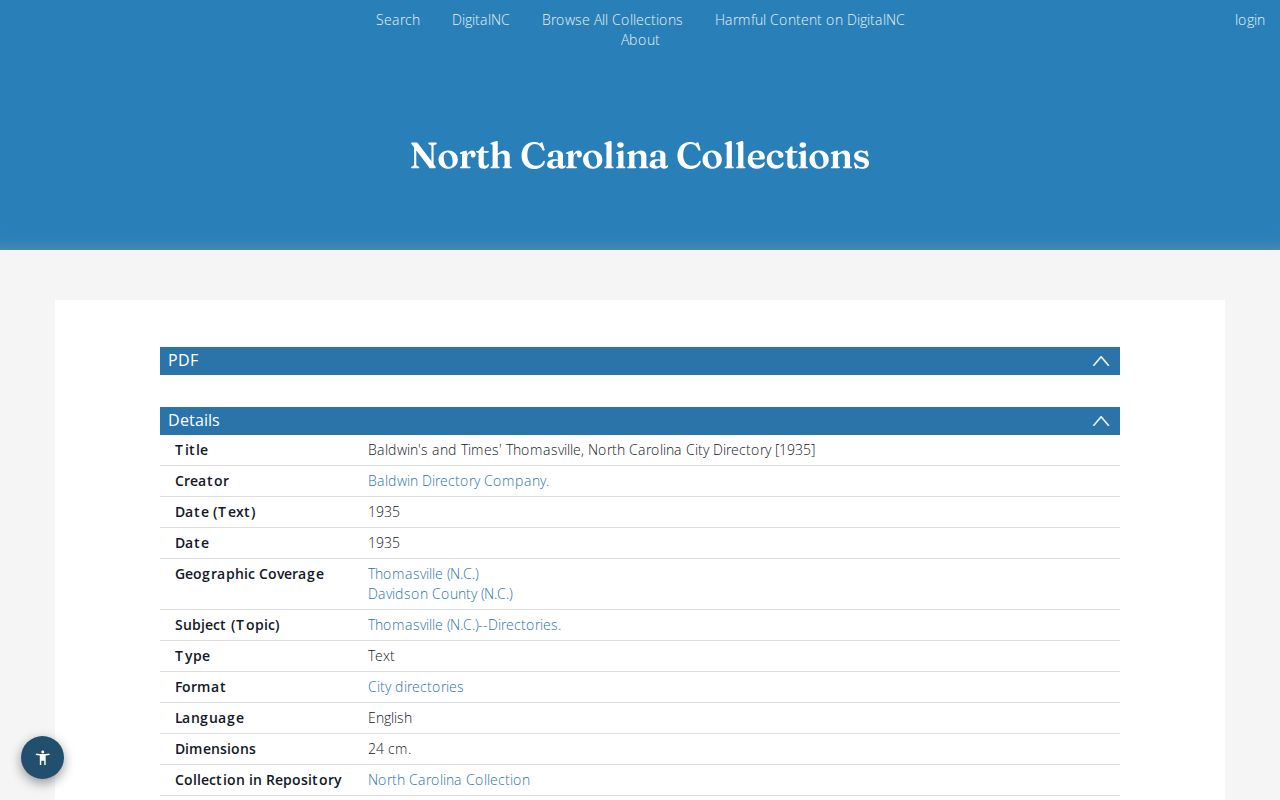
Keep a non-sensitive inventory of the fields and page location rather than reproducing a long household entry when a shorter citation will support the research trail.
Thomasville City Directories and Street Names
Thomasville's railroad-centered layout adds a local trap to city directory reading. Historic North and South Main streets on either side of the railroad were eventually renamed West and East Main. The county's uniform 911 road-name and address program later targeted an April 27, 1992 start. A literal search for a current street string can therefore miss an older line, even when the house and family are related to the same place.
Write the historic label and current label in separate fields. Then compare the directory page with a dated map, deed description, or Sanborn sheet before merging them. The county historical map collection includes dates from 1868 through 1938, and the 1890 map has a Thomasville inset with families. That is useful context for a street name, but neither map nor directory proves a continuous modern address on its own.
Thomasville City Directory Community Clues
Directories preserve a narrow printed view. The Davidson County Historical Museum supplies another route through vertical files, a research library, historic-preservation leads, maps, and community material. Its Thomasville Black History collection was loaned by community members in 2023 and digitized. Church Street School, people, institutions, and civil-rights context in that collection can add local memory missing from a tax card or a one-line directory entry.
Use that material with care. A community collection may supply a name, place, or event worth pursuing, while an official or dated record tests the timing. The museum is a research and referral point, not the custodian of deeds or court files. The combination is especially useful where a historical household crosses school, church, furniture, railroad, and neighborhood history.
The museum's community-resources page connects researchers with its historical holdings and house-history referrals.
Bring the exact directory citation, known street spellings, and a date range so a museum or library referral can start with a defined question.
Trace Thomasville Households Across Directories
To trace a household, start with one dated directory and move in both directions through the available Thomasville city directory run. An entry that changes from a street address to Rural Delivery, or appears under a different Main Street direction, calls for an address crosswalk before it is treated as a move. Pair the nearest census schedule with the directory edition when census context is available. The directory creates a point between census snapshots; it does not replace the census household record.
- Choose the first matching name, street, or household clue and capture the book title, year, publisher, page, and exact spelling.
- Check the edition's general index and street-side material to see whether the same address or a related household line appears.
- Move forward and backward through the documented volumes, recording each address form rather than silently normalizing it.
- Pair the closest census schedule with the directory date, keeping a separate note for names that match but have a different address or age context.
- Use the Dispatch obituary indexes, cemetery volumes, newspapers, deeds, or Sanborn maps to test a disappearance, death date, transfer, or building change.
The Dispatch indexes cover 1888-1948, 1951-1975, 1976-2000, and 2001-2009. Davidson cemetery Volume VII covers Thomasville and Volume VIII covers Thomasville Area. Those sources can confirm a date or family connection, but neither shows that a person was the final household at an address. When the question shifts from a historical shelf to one modern name, use the official record that matches the date and fact being tested.
Thomasville City Directory Gaps and Limits
Thomasville's records also carry a preservation story. Davidson County's 1858 courthouse burned in 1865. Repairs followed, and the 1902 fire led to fireproof vaults and a 1903 courthouse. That history is not proof that every early record vanished. Surviving material can be in original books, microfilm, State Archives county-record groups, local finding aids, newspapers, or library collections. A missing name deserves a search of the relevant custodian and collection before it is called lost.
Directory lines should remain dated evidence. They can identify an address association, a spouse notation, a listed role, or a business entry for the edition in hand. They do not prove a current address, legal title, or an entire household. Preserve uncertainty and compare independent sources.
Use records safely. Thomasville city directory material is for personal and family-history research. Do not use historical address information to track, threaten, stalk, harass, or harm a living person.